Showing posts with label chemistry and life. Show all posts

10/2/15

Public attitudes to chemistry: RSC science communication competition 2015 and win £500

If you are passionate about writing science and making video, you may win £500 from Royal Society of Chemistry.

What to write?

An 800 word long essay about public attitudes to chemistry. May cover topics like:

- Chemistry is something you do at school, not something you do in your everyday life
- How chemistry relates to energy, environment, food & water
- Emotional responses to chemistry
- Unpicking the confusion between pharmacists and chemists
- Why chemists think the public are more negative about chemistry than they actually are


A less than 2 min video.

Deadline

8 January 2016 11.59 pm GMT

Prizes


- Receive £500
- Be published in Chemistry World 
- Have the opportunity to take part in a special assignment with Chemistry World 
- The four remaining finalists will receive £250.
For details click here

11/20/12

£250 prize for schools electrochemistry challenge

The RSC's Electrochemistry Group is inviting students to enter a competition to design a battery and win up to £250.
The competition asks students 'Imagine you had a power cut at home - what could you use to produce some power?' The group are looking for the most imaginative solution that uses materials found in the home and garden.
Lemon connected to a multimeter
A separate set of prizes is available to the best entry of a cartoon or illustration that demonstrates an electrochemical principle. Again, the judges are looking for creativity and entrants are asked to 'think different!'
More information can be found on the RSC Electrochemistry Group website. The deadline for entries is 15 December 2012.

more here: http://www.rsc.org/Membership/Networking/InterestGroups/Electrochemistry/electrochemistry-challenges.asp

8/10/12

Chemistry experiments on Mars by "Curiosity rover"

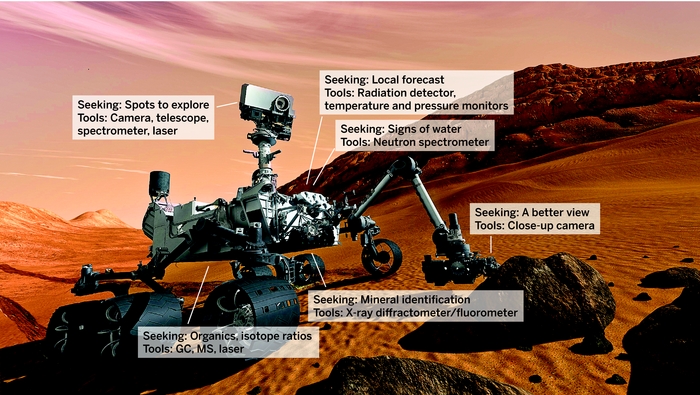
NASA's new Mars rover Curiosity has landed on Mars surface after a ~year journey (354 million miles) and already started sending photographs of the red planet. This $2.5 billion rover will stay in the red planet for 2 years and will explore and help us understand whether this planet has ever been able to support any kind of life. To answer this BIG question, Curiosity will collect rock/soil/dust samples and will perform whole bunch of analytical chemistry to analyse them.

Curiosity is basically an entire chemistry lab containing variety of 10 analytical equipments, which can test the chemical composition of soil, packed in one mobile unit. Lets see what analytical equipment it has and 
  1. The Chemistry and Mineralogy (CheMin) Instrument: It is a powder x-ray diffraction with x-ray fluorescence capabilities and will tell something about mineral composition of Mars.
  2. Chemistry and Camera (ChemCam) Instrument:  ChemCam fires invisible laser pulses at a target. It then views the resulting spark with a telescope and spectrometers to identify chemical elements. 
  3. The Sample Analysis at Mars (SAM) instrument:  It has three laboratory tools for analyzing chemistry. The tools will examine gases from the Martian atmosphere, as well as gases that ovens and solvents pull from powdered rock and soil samples. SAM focuses on the detection of organics and the characterization of compounds in the Martian soil that could be used as nutrients for life, in particular nitrates and perchlorates. 
  4. The Rover Environmental MonitoringStation (REMS) instrument: REMS will provide daily weather reports from the Red Planet. It consists of a suite of meteorological instruments that will record hourly measurements of wind, pressure, temperature, humidity, and ultra violet (UV) radiation. 

Watch these videos.


Test results from these instruments will pave the way for future Mars missions, and may provide insight in the search for life on other planets.


4/1/12

Instruments/equipments in a microfluidic laboratory

I am presenting the instruments/facilities that we use in our microfluidic/nanofluidics instrumentation laboratory. We primarily fabricate glass based microfluidic devices ourselves and use them for different biological applications.

1. We have a basic photolithography setup that includes a dark room, UV light source and developing solution.
2. Then we perform wet chemical etching to make channel networks on the substrate glass plate using BOE (buffered oxide etchant) which is an appropriate mixture of HF and NH4F.

Chemical wet etching setup

The BOE solution is heated to certain temp to fasten the etching rate and stirred continuously to have uniform etching. The solution on the right is Chromium etchant which removes chromium layer from the substrate plate.

3. Sand blaster is used to make holes to have access to the channels. It uses 25-50 micron  sand particles which are bombarded on the surface of glass substrate. It makes holes of ~1mm diameter.
Sand blaster to make holes

6/30/11

Chemistry of Wine

Why do you drink wine? For pleasure, health, sociality or no wine? My guess is most of you drink wine for pleasure.


This video was produced by ACS (American Chemical Society) as a webinar presented by Ariel Fenster of McGill University. He uncorks everything you need to know about wine (the history of wine as well as the chemical aspects of fermentation and of aging). Watch this video, it is ~1 hr long.


Some Facts:


- Wine is not the number one in alcoholic beverage, this title goes to Beer. When you talk about wine, France comes first. In France wine consumption is 55 liters/year/person.  This means roughly 5 liters in a month and ~166 mL per day.


- On Canary Island, a child has to take wine bath believing to get some health benefit. 


- 100 Calories/glass of wine, mostly coming from ethanol, small amounts of vitamins (Niacin, Pantothenic Acid, Pyridoxine) 


- Alcohol is converted into acetaldehyde and is responsible for hangover, when you drink too much acetaldehyde doesn't have enough time to get converted into acetic acid. Build up of acetaldehyde is responsible for unpleasant effect of hangover.


- There is belief that wine reduces heart attack, Alzheimer disease.

4/11/11

Chemistry Matters: Beauty

From molecules to equations to experiments, learn how and why chemistry is beautiful to Nobel Laureates. This video is one in a series of four, short educational videos capturing 16 Nobel Laureates' opinions on why chemistry matters. 

3/27/11

What is Nuclear Disaster? # Nuclear Reactor Leaking in Japan# Video

Last few weeks Japan is facing natural and man made disaster. After the massive earthquake, Sendai and neighboring regions were heavily affected by Tsunami which causes huge loss of human life and other physical structures. Tsunami also damaged nuclear power plant. There are lots of rumors about harmful radiation leaking from the damaged power plant. Video below explains in simple way about nuclear power plant and its safely issues.

3/22/11

Chemistry Beyond the Textbook: 16 Nobel Laureates Speak

Learn about chemistry's many facets as explained by Nobel Laureates and discover why would one claim that chemistry is the 'queen of all sciences'. This video is one in a series of four, short educational videos capturing 16 Nobel Laureates' opinions on why chemistry matters.

2/26/11

The Life of a Chemist: Chemistry Matters to Everyone


On the occasion of Internal Year of Chemistry (IYC 2011), Nobel organization has produced four short videos related to chemistry specially designed for students aspiring to a career in chemistry. In all the videos called "Chemistry Matters", 16 Nobel Laureates discuss new frontiers in their field and explore what life as a chemist entails. They also describe the beauty inherent in chemistry and recall the eureka moments when they discovered 'a little of nature's logic'.


In this video, they focus on the Life of a Chemist. Being a student of chemistry, one plans to spend his/her life as a chemist. Chemistry really matters to everyones life, the way we want to have our life. Watch the video below and know how all Chemistry Noble laureates spend their life on regular basis. 


2/18/11

A Day Without Chemistry: NOT POSSIBLE

Imagine a day without cars, electric lights, TV, telephones, safe food, and water, medicine, clothing, your house, and thousands of other familiar objects that make up modern society. Do it, and you are imagining a day in a world without chemistry.

What would the world be like without chemistry? 


A short animation created by the American Chemical Society (ACS) shares one humorous take on all that we owe to chemistry. The animation was created to celebrate 2011, the International Year of Chemistry (IYC).  A Day Without Chemistry follows a young man as he sees more and more of his everyday necessities and conveniences disappear before his eyes.


Watch this video. 2011 is the year of Chemistry!! It is being celebrated worldwide.

2/13/11

Chemically Perfect Perfume (Valentine's Day special)

For those who want to do something special in valentines day, we present a chemistry related video. In this video, a famous professor who makes youtube videos on chemistry related subjects talks about chemistry of perfume. Enjoy it and have happy valentines day to all chemists out there.


1/2/11

DEATH BY POTASSIUM PERMANGANATE [KMnO4]

KMnO4 Solution
ANANT BABU MARAHATTA
Ph.D. student
Tohoku University, Japan

Potassium permanganate is not a new chemical for the chemists as well as for other scientists. It is generally used in even very simple lab. It is a crystalline, colored substance and soluble in water. Its salts are normally stable in crystalline form but Zinc permanganate can become explosive. In fact, storing it in tightly stopper bottles is highly dangerous. The color of the solution of KMnO4 is differed depending upon its concentration. If the concentration is about one part per million (1 PPm), the solution has a faint pink color. When the concentration is one part in 76000 (65mg/4.5dm3), the fluid becomes purple. Because of its color, solution has been used for staining purpose too. Those who use the chemical as a stain for flooring and woodwork and work with the concentrated solution must exercise with great care.

12/22/10

DEATH BY COMMON SALT [NaCl]

Anant Babu Marahatta
Ph.D.student in Chemistry
Quantum Chemistry group, Department of chemistry, Tohoku University, Sendai,Japan


There is no doubt that common salt or sodium chloride (NaCl) is indeed essential to all life. It is the basic milieu of mammals. It occurs as colorless cubic crystals or as white crystalline powder. It is available at everyone’s home as well as in laboratory. No one suspect that it is a poison. One who studied biochemistry must have learnt that salt is a poison and can be used to kill infants. It is indeed a rather safe poison because one doesn’t need to buy anything when salt is administered in larger quantities than required, it can cause death too.

One teaspoonful of salt weighs about 5gms. Normal uptake by adults is about 5 to 15gm daily or about 1-3 teaspoonfuls. Children consume less salt is even necessary for normal growth. The sodium needed for growth is 0.5 mEq/kg from birth to 3 months of age, which decreases to 0.1mEq/kg at 6 months. The average content of sodium in human milk is 7mEq/L and that in cow milk is 21mEq/L.


Since, chemists and biochemists find it easier to talk in terms of equivalent weights. Equivalent weights are actually measures of the characteristic proportions in which the given elements combine .As we all know that 1mEq.sodium equals 23 mg and that of NaCl equals 58.5mg, and 1mEq would be equal to 1/1000 Equivalent weight. Thus, when one says that sodium needed for growth is 0.5 mEq/kg from birth to three months of age; he simply means that for every kg of baby’s weight, 0.5mEq of sodium is needed. Thus if the infant weighs, say, 4kg he would need 4 x 0.5 or about 2mEq of sodium. Since 1mEq of sodium is 23 mg, it would mean that the infant would need about 46mg of sodium daily. This much sodium would be available from about 117 mg of salt. Similarly we can convert other values given above.

Most people will not believe that common salt is a deadly poison. The only difference between this and other commonly known poisons is that one has to administer rather large quantities. One or two tea spoonfuls of salt would not kill an adult but can easily kill a 6 month old baby. About 40 teaspoons of common salt would kill an adult human being too. The toxic oral dose of salt is 0.5 to 1.0 gm/kg. For a 70 kg man this amount is about 35-70 gm. That means if an adult consumes about 70 gm of salt [or about 14 teaspoons], he would be severely poisoned. The estimated fatal amount, i.e. amount sufficient to kill, is about 1 to 3 gm /kg [remember that weight of one teaspoon common salt is about 5 gm.]. This amounts to about 70 to 210 gm. [about 40 teaspoonfuls] of salt for a 70 kg man.

Interestingly, the Chinese used saturated salt solution for suicide. Salt intoxication and death have occurred when it is used to induce vomiting as well. When some body has consumed a poison, it is imperative to remove as much poison from his stomach as possible. One of the best ways to do this is to make the person vomit. It has been known from the ancient times that a strong solution of common salt induces vomiting and that is why for centuries, it was a favorite method of doctors to induce vomiting for poisoned patients. But now it is known that saturated solution of salt itself can cause salt poisoning, so it is rarely used these days. Thus accidental poisoning and death takes place due to the common salt if the person consuming less harmful poison is induced vomiting by injecting saturated salt solution orally. This is the most common accident frequently observed in the society.

THUS, THIS IS OUR WORK TO MAKE THE SOCIETY AWARE ABOUT THE SALT POISONING. SALT SOLUTION INFACT INDUCES VOMITTING BUT ITS HIGH CONCENTRATION ACTS AS FATAL.


DOCTORAL EVIDENCES OF COMMON SALT POISONING


The stomach contents and the blood analysis of the person poisoned by common salt tell the doctor that salt has been administered to the patient. While examining the brain tissue under the microscope, it has been found the capillaries of the brain are damaged and they are full of blood. There are innumerable bleeding points- technically known as hemorrhages in the brain. Many venous channels of the brain called dural sinuses are blocked. All these findings are strongly in favor of salt poisoning.

11/24/10

Thanksgiving and Chemstry: Whats connection?

Thanksgiving is a traditional holiday in north America and is one of the biggest festivals in the US. People basically cook turkey, mashed potato, invite people and enjoy food. One blog posting about thanksgiving is here. So, then what is to be with chemistry? To know the connection between thanksgiving and chemistry, watch video below. This video was produced by ACS (American Chemical Society). Chemistry Prof. Diane Bunce explains things like:

• How does the pop-up timer in a turkey work?
• Why do muffins rise, even when made without yeast?
• Which antacids neutralize the most stomach acid?


9/4/10

Poem: You have become a catalyst In every reaction of my heart

By Sunil Hamal

As firstly I glanced upon you
Love was precipitated in chemical point of View
Since then you were in my mind
I felt civitone was spread behind

Your oxygenic appearance
made my heart water as if it were of hydrogen
It started to warm up rapidly
Which used to be liquid nitrogen

In your facial electronic cloud
I found myself lost
You have become a catalyst
In every reaction of my heart

Once when you touched me
That acted as salt-bridge
Our hearts being electrods
Exchanged love with great ease

3/21/10

Chemistry Jokes: Humor Chemistry-I

1. What did one atom tell another? 
   - I think I lost an electron 
   - Are you sure? 
   - Yes, I'm positive. 

2. Heisenberg is out for a drive when he's stopped by a traffic cop. 
The cop says: " Do you know how fast you were going? 
Heisenberg replies: "No, but I know where I am".
 

2/13/10

Chemistry of LOVE: Valentines day Chemistry

February 14th is Valentines day. No need to explain about this day to you. You may be planning to celebrate this day in your way!! To find your love and to have a long term relationship, there is one saying that you should have right chemistry or chemistry should match. For two people to fall in love the chemistry between them has to be just right.

“In chemistry different atoms and compounds combine together to form stable molecules and complexes, In the same way, if you get the right two people they will react together and make a very stable combination."

Do you believe in love at first sight? Or that the subtle scent a person gives off can attract or repel you? Or would you like to know why chocolate just makes everything better? Is romance all about chemistry

Some chemicals that come across love.